Executive summary
The situation. Rural Louisiana veterans and families navigate a fractured landscape — the services exist, but they sit in separate organizations with separate intakes, separate data, and no shared accountability. Lighthouse already operates the pieces: outreach, navigation, housing, giving, and volunteers. What it has not yet done is operate them as one governed system that can prove its results.
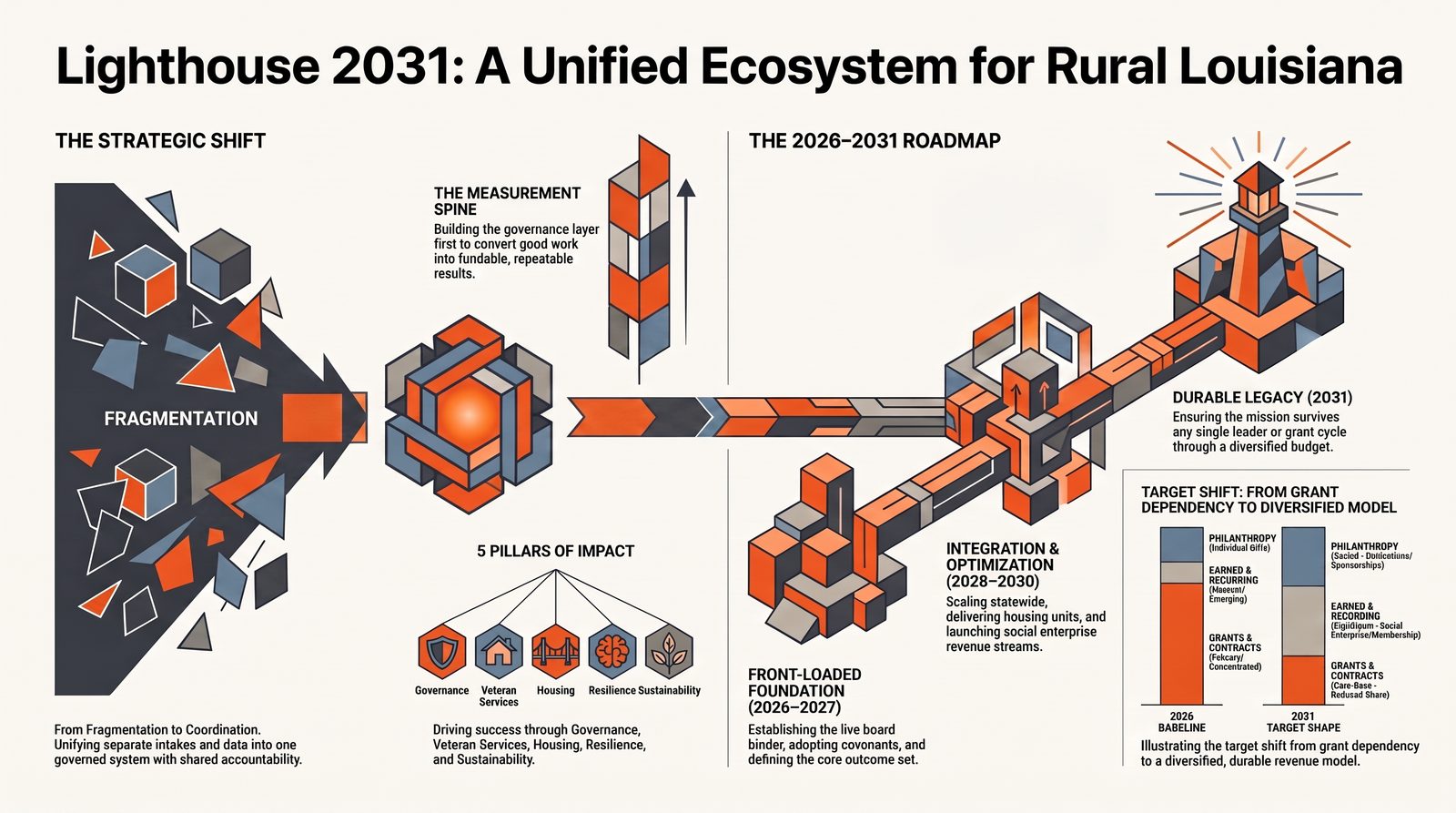
The strategy. Over five years the enterprise moves from four organizations that cooperate to one coordinated ecosystem with a single measurement spine. Five pillars carry the work: governance, veteran services, housing, resilience, and sustainability. Every pillar reports into one board binder and one dashboard.
The bet. Institutional capacity is the constraint, not goodwill. Funders increasingly buy documented systems, not intentions. Building the governance and measurement layer first is what converts good work into fundable, repeatable, durable work.
The proof. By 2031 the enterprise should be able to answer, with published numbers: how many veterans were housed and stayed housed, how many benefits were secured, how many parishes are disaster-ready, and how much of the budget no longer depends on any single grant.
Where the enterprise stands today
An honest baseline is the first act of a credible plan. This is the starting position the strategy is built on — assets already in hand, and gaps that must close.
What is already real
- Four legally distinct entities with complementary mandates, already operating
- Mobile outreach in the field and a documented navigation doctrine
- A public website capturing intake, partner, and sponsor inquiries into one database
- A published governance library — twenty anchor documents in one place
- Named housing discipline (accessory dwelling units) with a due-diligence toolkit
- An emerging local coalition in East Feliciana and existing regional partners
What is not yet true
- No single published outcome set — results live in stories, not numbers
- Revenue concentrated in grants and contracts; little earned or recurring income
- Founder-dependent leadership; succession and bench strength unproven
- Housing pipeline not yet expressed as named projects with documented demand
- Volunteer capacity real but informal — unlogged, so it counts for nothing on paper
- Case data not yet flowing end to end from field intake to board reporting
SWOT analysis
Internal factors we control (strengths, weaknesses) set against external factors we must navigate (opportunities, threats). Read it as a whole: the plan's job is to use strengths on opportunities, and to keep weaknesses from meeting threats unguarded.
TOWS matrix — what the SWOT tells us to do
A SWOT that stops at four lists is a wall decoration. The TOWS matrix pairs the quadrants to generate actual strategies: attack with strengths, fix weaknesses to capture opportunities, defend with strengths, and protect where weakness meets threat. Every strategy below maps to a pillar.
| Opportunities (O) | Threats (T) | |
|---|---|---|
| Strengths (S) |
SO — Attack
SO1. Convert field outreach into published evidence: log every encounter, report outcomes quarterly, and lead grant applications with proof. → Pillars 1, 2SO2. Formalize the East Feliciana allies into a named coalition and apply as a coordinated rural partnership. → Pillars 3, 5 SO3. Turn the housing doctrine into named projects, using documented demand as the case for funding. → Pillar 3 SO4. Launch social enterprise (culinary, catering, membership) on the trust the brand already holds. → Pillar 5 |
ST — Defend
ST1. Use the multi-entity structure to spread funding risk — no single entity carries the whole exposure. → Pillar 5ST2. Convert disaster exposure into a funded capability: pre-positioned resilience protocols make the enterprise the partner of choice when events hit. → Pillar 4 ST3. Lead with governance quality to win competitive pools other applicants cannot document. → Pillar 1 ST4. Grow talent locally through training cohorts rather than competing for scarce hires. → Pillars 2, 5 |
| Weaknesses (W) |
WO — Fix to capture
WO1. Stand up the measurement dashboard before the next major application cycle — the missing outcome set is the binding constraint on funding. → Pillar 1WO2. Formalize the volunteer corps so donated expertise becomes countable community capacity. → Pillars 4, 5 WO3. Build back-office capacity (finance, compliance, reporting) ahead of growth, not after it. → Pillars 1, 5 WO4. Pursue housing designations that unlock dedicated federal funds. → Pillar 3 |
WT — Protect
WT1. Build an operating reserve and a cash-timing plan to survive reimbursement gaps. → Pillar 5WT2. Write and adopt a succession plan — emergency and planned — to retire key-person risk. → Pillars 1, 5 WT3. Adopt audit-ready compliance practice now, while the stakes are still small. → Pillar 1 WT4. Diversify revenue deliberately so no funder shift can end a program. → Pillar 5 |
Across all four quadrants, one theme repeats: the enterprise's service capability outruns its measurement and financial infrastructure. Every quadrant points to the same first move — build the accountability and sustainability layer now, so the field work already happening becomes provable, fundable, and durable. That is why Pillars 1 and 5 lead the sequencing even though Pillars 2, 3 and 4 are the visible mission.
Mission · Vision · Values
Service — where every veteran is a mission.
Legacy — build what outlasts us.
Theory of change
The logic chain a funder will test: what we put in, what we do, what comes out, what changes for people, and the long-term impact. If any link breaks, the plan fails there — which is why each stage carries its own measures.
Five strategic pillars
Each pillar states a goal (the destination), objectives (what must become true), and initiatives (what we actually do). Owners and timing are named so the plan can be held to account rather than admired.
Goal. The enterprise governs itself well enough that any funder, auditor, or partner can see how decisions are made and how results are tracked.
2. Reporting moves from descriptive to predictive
3. The values covenant is formally adopted across all four entities
4. Compliance practice is audit-ready before scale demands it
• Stand up the executive dashboard with real inputs
• Board-approve the covenant and the code of conduct
• Publish a compliance calendar and risk register
• Write emergency + planned succession
Goal. Every veteran who touches the enterprise gets one assessment, one plan, and one team — and the results are recorded.
2. Federal and state long-term-care pathways are integrated into one route
3. Field intake flows straight into the measurement system
4. Survivor and caregiver needs are served, not deferred
• Digitize intake at the point of contact
• Publish a parish-level referral map with partners
• Add warm-handoff protocols with health and workforce partners
• Quarterly case review across entities
Goal. Move from housing intentions to named projects, delivered units, and permanent affordability.
2. Federal housing designations pursued and secured
3. A permanent-affordability vehicle established
4. Property operations run to a written standard
• Convert intake housing responses into demand evidence
• Complete readiness assessment for federal designation
• Form the land-trust vehicle and adopt the resale formula
• Adopt the property management manual and inspection cycle
Goal. When the next storm comes, the enterprise is a designated part of the response — not a bystander scrambling.
2. Mobile deployment packages ready to roll
3. Volunteers trained to a recognized incident standard
4. Continuity of operations assured for the enterprise itself
• Build and stock deployment kits; run an annual drill
• Train the surge corps to incident-command roles
• Sign mutual-aid agreements with parish partners
• Write and test the continuity plan
Goal. The mission survives any single funder, any single grant cycle, and any single leader.
2. An operating reserve covers a real cash gap
3. A second and third leader are ready for every critical role
4. The model is documented well enough to replicate
• Launch monthly membership and sponsored training seats
• Build the memorial dedication program
• Set a reserve policy and fund it deliberately
• Run leadership development and document every core process
Five-year roadmap
Five phases, with the pillar work laid across them. Note the deliberate front-loading: governance and sustainability start first because everything else depends on them.
Balanced scorecard & KPI framework
Four perspectives, so no single lens dominates: the people we serve, the money, the way we work, and how we grow. Baselines are set at adoption; the trajectory column shows the intended direction of travel, not a promise.
| Perspective | Indicator | Pillar | Direction of travel |
|---|---|---|---|
| Mission (those we serve) | Veterans contacted and assessed | P2 | grow steadily |
| Benefits secured (claims paid) | P2 | grow steadily | |
| Housing stability at 12 months | P3 | hold high | |
| Employment placement after training | P2 · P5 | grow steadily | |
| Financial (the money) | Revenue diversification — share from largest single source | P5 | reduce concentration |
| Earned + recurring revenue as share of budget | P5 | grow deliberately | |
| Operating reserve — months of cost covered | P5 | build to policy level | |
| Community investment leveraged per dollar raised | P3 · P5 | grow steadily | |
| Process (how we work) | Field encounters recorded in the system (data capture rate) | P1 · P2 | approach full capture |
| Housing units delivered (cumulative) | P3 | compound | |
| Preparedness: plan adopted, kits ready, drill completed | P4 | reach full readiness | |
| Audit findings closed within the cycle | P1 | hold near complete | |
| Learning (how we grow) | Leadership bench — critical roles with a ready successor | P5 | cover every role |
| Volunteer hours logged (community capacity) | P4 · P5 | grow steadily | |
| Partnership agreements active | P1 · P3 | grow steadily | |
| Core processes documented (replication readiness) | P5 | reach complete |
The revenue shift — from dependent to durable
The single biggest financial risk is concentration. This is the intended change in the shape of the budget: grants stay important but stop being the whole story, while earned, recurring, and philanthropic income grow into a real base.
Risk register & heat map
A plan that names no risks has not been thought through. Each risk is placed by likelihood and impact, then assigned an owner and a response. Red risks are reviewed at every board meeting; amber quarterly; green annually.
| # | Risk | Response strategy | Owner | Rating |
|---|---|---|---|---|
| R1 | A major funder shifts priorities or a contract is not renewed, removing a large share of revenue at once. | Diversify deliberately (Pillar 5); no single source above the concentration threshold; build the reserve; keep a live pipeline of alternatives. | Exec Director + Finance | Critical |
| R2 | Loss or unavailability of the founder or another critical leader. | Written emergency and planned succession; document every core process; develop a second and third capable person per role. | Board Chair | Critical |
| R3 | Reimbursement timing gaps strain payroll and operations. | Cash-flow forecast maintained monthly; reserve policy; line of credit explored; invoice discipline and draw calendars. | Finance lead | Elevated |
| R4 | At renewal, outcomes cannot be evidenced because data was never captured. | Measurement stood up first (Pillar 1); capture at point of contact; publish results quarterly whether or not anyone asks. | Exec Director | Critical |
| R5 | Construction, insurance, and materials costs outrun the housing model. | Conservative feasibility assumptions; phase projects; small-footprint first; contingency in every capital stack; local partnerships for in-kind capacity. | Housing Director | Elevated |
| R6 | Staff do not adopt the data system, leaving the dashboard empty. | Design intake around the field worker, not the report; train and support; make the system the only path to a completed record. | Operations lead | Monitored |
| R7 | A disaster pulls the whole team into response, stalling planned work for months. | Continuity plan; surge corps absorbs demand; treat response as a funded capability with its own resources rather than an unbudgeted diversion. | Operations lead | Elevated |
| R8 | Coalition partners disengage; agreements lapse. | Written agreements with review dates; visible shared wins; quarterly convening; make participation valuable, not ceremonial. | Exec Director | Monitored |
Stakeholder map
Plotted by influence over the plan and interest in its success. The rule of thumb: manage closely in the top right, keep the top left satisfied, keep the bottom right informed, and monitor the rest.
How the plan stays alive
Most strategic plans die in a drawer. This one has a calendar, an owner for every review, and a rule: if a pillar has no update, that absence is itself reported to the board.
| Cadence | What happens | Who owns it | Output |
|---|---|---|---|
| Monthly | Operations review — activity volumes, cash position, immediate blockers | Executive Director | Operations note |
| Quarterly | Strategic review — pillar progress, KPI movement, risk register refresh, corrective actions | Exec team + Board committee | Quarterly strategic review |
| Quarterly | Published outcomes — results go out whether or not a funder asked | Measurement lead | Public results summary |
| Annually | Strategy deployment plan — next year's objectives, targets, budget alignment | Board + Exec Director | Annual deployment plan |
| Annually | Governance review — covenant, policies, succession, compliance calendar | Board Chair | Governance memo |
| Year 3 | Mid-plan reset — revisit SWOT, re-test assumptions, adjust pillars if the ground has moved | Full board | Revised plan |
Assumptions this plan rests on
If any of these prove false, the plan needs revisiting — not quiet abandonment. Naming them now makes the mid-plan reset a discipline instead of a crisis.
What success looks like in 2031
Written in the past tense on purpose — this is the report the board should be able to give five years from now.
The enterprise no longer describes its work; it reports it. A veteran met at a roadside outreach stop in a rural parish is assessed once, planned with once, and tracked all the way to a paid benefit, a job, or a front-door key — and that journey shows up in a dashboard the board reads and funders can see.
Housing is no longer a thesis. There are named projects, delivered units, and a land-trust vehicle holding affordability in place for the next generation of families. The waitlist is documented, and it is the evidence behind the next application.
When a storm comes, the enterprise is on the response roster — plan adopted, kits stocked, corps trained — and its own operations keep running while it serves.
The budget no longer holds its breath at renewal season. A cafe, a training school, a membership base, and a memorial program carry real weight beside grants, and a reserve stands behind payroll.
And the institution outlives any one person in it. Every critical role has a successor. Every core process is written down. The model is documented well enough that another rural parish could run it. Flags planted, families nurtured, legacies harvested.
Connections to the other anchors
This becomes the enterprise's plan only when leadership shapes it. Before adoption:
- Does the SWOT read as honest? What did we overstate, and what did we leave out?
- Of the sixteen TOWS strategies, which three should own the first year?
- Which KPIs become real board-adopted targets, and what are today's true baselines?
- Are the risk ratings right — and is anything missing from the register?
- Which assumptions worry you most, and how would we know early if one is failing?
- Who else must review this before the board votes?